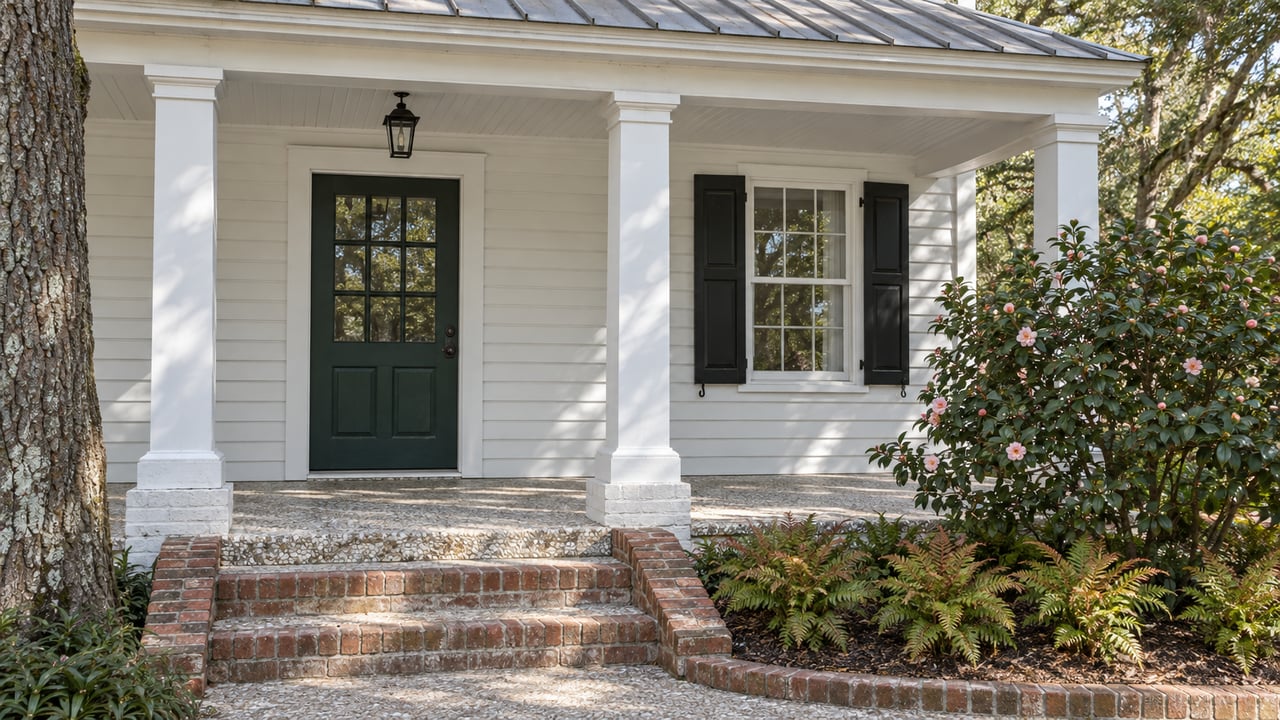
A detached cottage behind a St. Simons Island home now carries a date that matters. Glynn County's rewritten Zoning Ordinance took effect July 1, 2026. It says an accessory dwelling can be rented only long-term, meaning more than 30 days at a time. The one exception is an accessory dwelling that already had a short-term rental certificate issued before that date. A different chapter of the county code says that certificate "is not assignable or transferable."
The two codes overlap on the cottage most buyers are looking at. It has a kitchen and a full bath, and the listing describes it as rental income. The short-term rental exemption runs to the cottage, while the certificate belongs to whoever holds it today. A buyer who wants the cottage to keep earning nightly or weekly rent needs to settle how those two rules interact before the due-diligence period ends.
Two Sentences, Two Codes, One Closing Table
The zoning language sits in Sec. 4.8.4 of the final Glynn County Zoning Ordinance. Its cover reads "Effective Date: July 1, 2026" and "Amended: September 17, 2026."
"The property owner may use either the principal dwelling or the accessory dwelling or both as long-term rentals (rentals of greater than 30 days at a time). If an accessory dwelling has a short-term rental certificate issued prior to the effective date of this ordinance, that accessory dwelling shall be exempt from this requirement."
The certificate rules are in Chapter 2-31 of the Glynn County Code of Ordinances. When a property sells, the new owner gets a 30-day grace period to keep operating as a short-term rental, but only if the new owner applies for a certificate within seven days of the sale. The chapter issues certificates to someone with an ownership interest or to a managing agency or agent, with a narrow allowance for a renter who has the owner's explicit written permission. Another provision says that after a revocation, a property can get a new certificate sooner than the usual 12-month wait if it "is sold to a new owner as part of an arm's length transaction." Throughout, the code treats a sale as the start of a new certificate.
Read literally, a buyer who closes on a St. Simons cottage this fall would be applying for a certificate issued after July 1, 2026. Whether the county treats the cottage's earlier certificate history as enough for the exemption is not answered in either code, and we found no published county guidance on it. Ask Glynn County planning and licensing staff in writing before you count rental income in your offer price. This is a transaction question for the county and your attorney, not something a listing description can settle.
Whether the Cottage Is an Accessory Dwelling at All
The rental question applies only if the building is legally an accessory dwelling, and the new definition draws lines many owners won't expect. Sec. 4.8.4 defines an accessory dwelling as a self-contained dwelling on the same lot as the main house "and not connected to the principal dwelling." It may have a kitchen.
| How the space is built | Status under Sec. 4.8.4 |
|---|---|
| Detached building with a full bath | Regulated as an accessory dwelling |
| Detached building with only a half bath | Not an accessory dwelling |
| Living space with a kitchen, sharing a common wall or breezeway with the main house and connected by a doorway | Not an accessory dwelling |
This reverses the old approach. When county officials held two public meetings at the Casino Building on St. Simons, The Brunswick News reported that the existing rule required accessory dwellings to be attached to the home or connected by a covered walkway. A proposed change would have allowed detached units up to 800 square feet. A separate Brunswick News report on a planning commission work session described a draft limiting detached units to 1,000 square feet and two bedrooms. The adopted Sec. 4.8.4 includes no square-footage cap. It allows one accessory dwelling per lot, requires compliance with the International Residential Code, prohibits manufactured homes, and says the unit "shall not be sold as a separate dwelling."
For a buyer, the breezeway, the doorway, and the bathroom count matter more than how the listing describes the space. A guest suite joined to the house by a breezeway with a connecting door falls outside the accessory dwelling definition. A pool house with a full bath falls inside it. Before you sign, confirm with the county which category the space you are paying for falls into.
The One-Acre Line Applies Only on St. Simons
For buyers hoping to add a cottage rather than buy one, the key rule is the lot size. Sec. 4.8.4 says that on St. Simons Island "a minimum lot size of one (1) acre shall be required for an accessory dwelling." When the Board of Commissioners unanimously adopted the rewrite on April 16, 2026, the county said the threshold was meant "to address density on St. Simons Island." The 60% site-coverage requirement still applies on top of it.
The debate behind those numbers came from the island. The Brunswick News reported that both Casino Building meetings drew more than 100 people. It also noted that nonconforming lots "are plentiful on St. Simons Island." At those meetings, Lauren Zinskie of the Golden Isles Association of Realtors said the 60% coverage limit would restrict development potential in districts that previously had no coverage limit. Realtor Missy Neu, a member of the Glynn County Mainland Planning Commission, said, "We're going to work to protect private property rights." She added, "There are lots of conflicts for regulations of existing structures." A representative of the Sea Island Homeowners Association asked the county to allow a period after adoption for residents to learn the new rules. In a letter to The Brunswick News, St. Simons resident Ann Pequigney argued that accessory dwellings could turn into second homes and that short-term rentals reduce long-term housing. The long-term-only rental rule reflects that concern.
Existing cottages on lots under an acre fall under the ordinance's nonconformity provisions in Sec. 8.4. Lawful uses and structures in place when the ordinance took effect may continue. A nonconforming use cannot be expanded, moved to a different part of the lot, or changed to a different nonconforming use. A nonconforming structure damaged by fire, flood, or storm can be rebuilt if its nonconformity doesn't increase and construction starts within five years. During the rewrite, The Brunswick News reported Planning Director Stephanie Leif as saying properties with nonconforming uses would be grandfathered. For a buyer, an existing cottage on a three-quarter-acre lot can stay. It just can't be enlarged into the guest house the buyer may have been picturing.
The County Can See Certificates
These details matter in practice because short-term rental certificates on St. Simons are recorded by owner and monitored. Unincorporated Glynn County requires a certificate before any rental of fewer than 30 days. Renewals moved to the OpenGov platform on November 1, 2025. Prior certificate records were not migrated to the new system, and new users had to create new accounts. The county's 2026 application guide lists a $150 fee for certificates filed before July 1, $75 for those filed after, and $100 for each annual renewal. Owners also remit a 7% accommodation excise tax by the 20th of each month.
At their October 16, 2025 meeting, commissioners unanimously approved a $64,806 purchase order for RentalScapes short-term rental management software from Deckard, paid from the FY26 Accommodation Excise Tax Fund. The county also runs a 24-hour complaint hotline at 912-859-3767. Because a certificate is tied to its holder, any cottage that changes hands this year will show up as a new application.
Questions for a Cottage Listing Before the Option Period Ends
- Ask the seller for the cottage's current short-term rental certificate and its original issue date. Confirm it was issued before July 1, 2026, and that it covers the accessory dwelling specifically.
- Ask Glynn County planning and licensing staff, in writing, whether the Sec. 4.8.4 exemption applies to a certificate a new owner gets after closing.
- Check how the cottage connects to the main house and how many bathrooms it has, and compare that with the table above.
- Confirm the lot's acreage from the survey. On St. Simons, one acre separates a cottage you can add from one you can only keep.
- If the lot is under an acre and the cottage already exists, assume it can be maintained and repaired but not enlarged or moved under Sec. 8.4.
- If you plan to keep renting, put the seven-day application deadline on your closing calendar. The 30-day grace period depends on it.
The September 17, 2026 amendment to the ordinance has not been explained in any local coverage we found. Check the current text of Sec. 4.8.4 against the posted ordinance during your option period rather than relying on a summary.
If a St. Simons cottage is part of what you're considering, JPW Realty can help you put these certificate and acreage questions to the county before you commit to a price, and track the answers through closing. Schedule a free consultation, and bring the listing.
