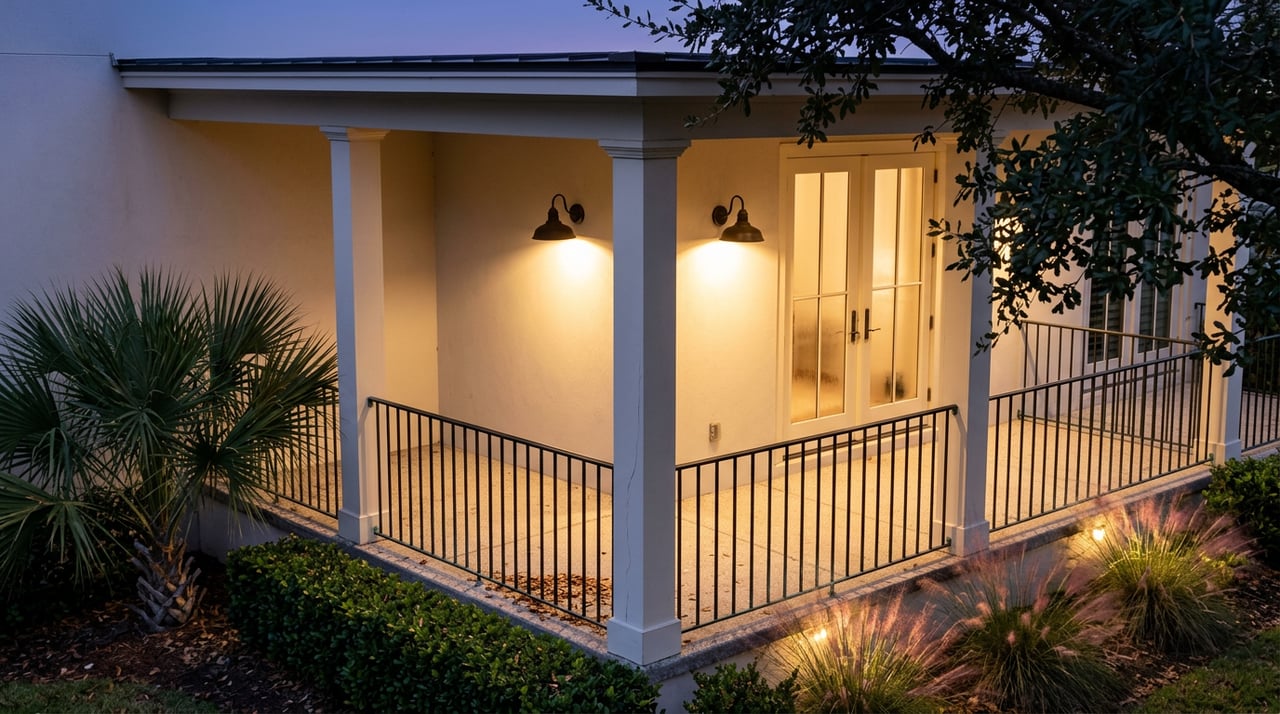
Glynn County's own press release calls it a rule that "preserves existing sea turtle protections while placing them in a clearer and more appropriate section of the ordinance." That is the official language, adopted unanimously by the Board of Commissioners on April 16, 2026, and it is technically accurate. It is also the sentence that will mislead almost every Sea Island homeowner who reads it and assumes nothing changed.
Something did change. It just doesn't show up on your property until you decide to touch the house.
What Actually Held Steady Since 1984
The county's beachfront lighting rule has said the same two things since 1984: light can't directly illuminate the beach, and any fixture visible from the sand has to be shielded. That baseline never moved through this rewrite. If your exterior lighting already met that standard last year, it meets it today, and it will meet it on July 1, 2026, when the new ordinance takes effect.
What the county's language glosses over is a fight that played out over roughly five months and ended in a compromise nobody fully got. Understanding that fight is the difference between reading the ordinance as a formality and reading it as something with a real trigger date attached to your address.
The Language That Got Written In, Then Erased
Georgia's Department of Natural Resources warned Glynn County that hatchlings navigate by heading toward the brightest point on the horizon. On an undeveloped beach that's moonlight on water. On a developed beach, it's a porch fixture or a pool light. A stronger draft released for public review on November 3, 2025 responded to that warning by adding real specificity: fixtures couldn't project light upward or illuminate vegetation and buildings, and any bulb had to fall in the amber or red LED range, at a wavelength of 560 nanometers or greater.
Between December 2025 and February 2026, that wording disappeared from the working draft. Catherine Ridley, who directs the St. Simons Island Sea Turtle Project and serves as vice president of communications for the conservation group One Hundred Miles, put the stakes plainly during the debate.
"If this ordinance passes the way it is, we'll not only be repeating the problems that we have had the last seven years, but we'll also be losing the same turtles needlessly."
The county released two more drafts, on February 17 and March 11, before commissioners deferred an initial vote in April to work out remaining objections. The version that finally passed kept the 1984 shielding language largely intact and moved it into a cleaner section of the code. The wavelength and directionality specifics that would have given the rule real teeth against existing fixtures did not survive.
Where The Rule Actually Attaches
Here is the part that matters if you own beachfront property on Sea Island and aren't planning to do anything to it this year: the new lighting standard applies when you pull a permit, not before.
Robert Ussery, a local architect who sat on the working group advising the rewrite, described the reasoning to The Current GA in terms that read almost like a real estate observation. Beachfront properties on Sea Island and the surrounding islands change ownership and get renovated often enough, he argued, that requiring compliance at each addition or modification would bring the whole stretch of beach into conformity over time, project by project, without forcing every existing homeowner to rip out fixtures on day one.
That means the ordinance touches your property under these circumstances:
- You add square footage, a pool, or an outdoor living space to a beachfront home
- You renovate in a way that requires a building permit
- You build new construction on a beachfront lot
It does not currently require you to change lighting you leave alone. Ridley's counterargument, made in the same reporting, is that this leaves the county without any mechanism to address non-compliant fixtures already in place on beaches that are, as she put it, nearly fully developed already. Whether that gap closes depends entirely on how many owners renovate in the coming years, which on Sea Island tends to be often.
The Clause That Made Realtors Push Back
The environmental debate wasn't the only friction in this rewrite. Lauren Zinskie, CEO of the Golden Isles Association of Realtors, raised a separate concern at one of the January public meetings on St. Simons: the stated penalty for a lighting violation was revocation of the property's certificate of occupancy.
Sharon Altenbach, representing the Sea Island Property Owners Association, backed that objection and added a second layer to it, pointing to safety concerns from residents worried about pool lighting and nighttime visibility for grandchildren. Assistant County Manager Danny Smith responded at the meeting that he didn't believe any certificate of occupancy would actually be revoked over a lighting violation.
That reassurance is worth taking seriously, but it is also worth confirming directly with the county's permitting office before you assume the risk is purely theoretical. If you are closing on a renovation permit or a certificate of occupancy inspection during nesting season, ask the specific question rather than relying on what a commissioner said at a January town hall.
Sea Island Was Already Ahead Of This
If you own on Sea Island specifically, there's a good chance your lighting habits are already closer to compliant than the county rule requires. Sea Island's own Adopt-a-Nest program has required members and guests to follow the county's seasonal lighting rule from May 1 through October 31 for years: no white lights visible on the beach at night, with red turtle-friendly fixtures as the accepted alternative. That resort-level standard predates the zoning rewrite and doesn't depend on which draft of the county ordinance survived.
The overlap is useful context, not a substitute for checking your own fixtures. A private club rule and a county zoning code are enforced by different bodies with different consequences, and the new ordinance's permit trigger applies regardless of what the resort's own guidelines already ask of you.
What This Means If You're Renovating This Season
The ordinance took effect July 1, 2026, which puts it squarely inside this year's nesting season, roughly May through October. If you're planning a renovation, addition, or new build on beachfront property on Sea Island in the near term, the practical sequence looks like this: your permit application is the moment the newer lighting section of the code applies to your project, and any exterior fixture visible from the beach needs to meet the shielding standard that has been in place since 1984. The stricter wavelength language that conservationists wanted didn't make it into the final code, so you are not required to install amber or red-only fixtures, though doing so keeps you aligned with what Sea Island's own conservation program already asks of members.
If you're buying a beachfront home with no renovation plans, the existing lighting stays exempt from the new section until someone pulls a permit for that address, whether that's you or a future owner.
Frequently Asked Questions
Does this apply to pool lighting? The ordinance addresses fixtures visible from the beach, which can include pool lighting depending on sightlines. Altenbach's safety concerns at the January meeting were specifically about pool and nighttime lighting, which suggests this is an area worth confirming with the permitting office on a project-specific basis.
Is the rule different on St. Simons Island versus Sea Island? The zoning rewrite applies countywide, but Jekyll Island, also in Glynn County but state-owned, adopted its own updated sea turtle ordinance back in 2008 and operates under separate rules.
When exactly is nesting season? Georgia's loggerhead nesting runs from roughly late spring into fall, with the county's lighting ordinance enforceable seasonally during that window rather than year round.
I just closed on a home with lighting that doesn't meet the standard. Am I required to fix it immediately? Based on how the final ordinance was written, compliance attaches at the point of renovation or new construction, not at the point of sale. If you have no immediate plans to alter the exterior, the existing fixtures aren't required to change under this specific section, though the older 1984 shielding rule still applies at all times.
Sea Island's building rules move at the pace of its renovation calendar, and reading the fine print before you pull a permit costs a lot less than finding it after. If you're weighing a purchase or a project on Sea Island and want a straight answer on how this affects your specific address, Pitts Wilson is a call away for a free consultation.
