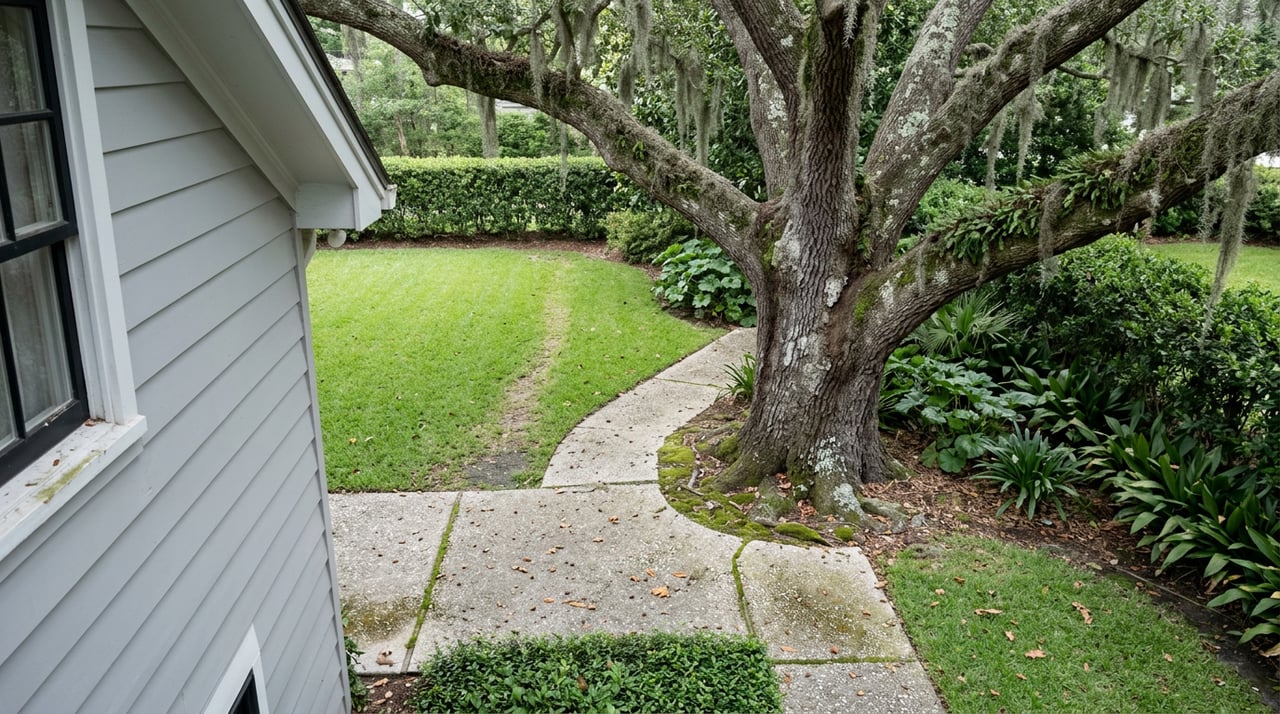
A six-unit condominium project at 1124 Postell Avenue had already cleared its Shore Protection Act permit, already had architectural drawings, already had a pool and driveway laid out on paper. Then the plans went back for a modification. The building footprint shrank. The pool got bigger. And the landscape plan gained a new native live oak, plus a grass swale carved into the lawn, specifically to satisfy Glynn County's tree canopy requirements before construction could proceed.
If a professionally represented commercial redevelopment on St. Simons Island had to circle back on its landscaping to satisfy the county, it is worth asking what happens to a homeowner who assumes a pool deck or a kitchen addition is a straightforward permit pull. On St. Simons, it usually is not, and the reason has nothing to do with the county being difficult. It has to do with a rule that was written to outlast every renovation on the island, and that most buyers only discover once they are already holding the keys.
The Rule Only Applies Here
Glynn County's tree canopy ordinance is not a coastal Georgia standard. It is written to apply specifically and only to St. Simons Island. Sea Island, Jekyll Island, and mainland Brunswick sit under different planning frameworks. For a buyer comparing a listing on St. Simons against one on Sea Island, or moving between the two as many Golden Isles buyers do, the assumption that "coastal Georgia rules are coastal Georgia rules" does not hold. What governs a renovation on one island does not automatically govern the other.
What Actually Triggers The Full Review
The county's tree plan requirement kicks in under specific conditions. A property owner needs an approved Tree Plan, reviewed and signed off before any site plan, building permit, preliminary plat, expedited subdivision, or land disturbance permit can even be submitted, if the project involves:
- Any commercial property, regardless of size
- Any industrial property, regardless of size
- Residential property of one acre or larger
Most single-family lots on St. Simons run smaller than an acre, so most homeowners never trigger the full review process described above. That is the good news. The detail that catches people off guard is this: regardless of lot size, an owner still needs the county's permission before removing a mature live oak. Being under the acre threshold exempts a property from most of the ordinance. It does not exempt the trees themselves.
Three Approvals Before You Can Even Apply For A Building Permit
For projects that do trigger the full review, the sequence runs through three separate stops before a builder can file for the permit that actually lets construction start:
- The Tree Plan goes to the county's arborist for initial review.
- The Tree Advisory Board considers the plan and issues a recommendation.
- The Islands Planning Commission takes up the plan for final consideration.
Only once that sequence is complete can the property owner apply for the site plan, building permit, or land disturbance permit the project actually needs.
A tree plan is not something you clear during closing. It is a queue you enter before you can even file for the permit that starts the work, and the length of that queue depends on committee schedules you do not control.
That distinction matters more than the ordinance's language suggests. This is not a fee tacked onto a renovation budget. It is a scheduling dependency, and scheduling dependencies are the kind of cost that never shows up in a contractor's initial bid.
The Canopy Math Behind The Paperwork
The county's stated goal is preserving at least half of St. Simons Island's tree canopy over time. The mechanism for getting there is a formula, not a flat rule. For projects subject to the ordinance, the required open soil area dedicated to tree growth equals the property's total square footage multiplied by 0.25. The county's own research assumes every square foot of preserved open soil eventually produces two square feet of canopy, which is why the open-soil requirement lands at a quarter of the lot rather than half of it.
On top of that percentage, the ordinance sets two more thresholds:
- A minimum of 12 large-canopy trees must be either retained or newly planted
- No individual open soil area set aside for tree growth can be smaller than 400 square feet
Species get sorted into large, medium, or small canopy categories according to the county's own tree board list, which means the value of an existing oak on a lot is not a matter of opinion. It is measured against a published standard the arborist applies the same way on every application.
A Rulebook That Just Got Rewritten
This spring, Glynn County finished a full rewrite of its subdivision regulations and zoning ordinance, with draft versions circulated for public review in November 2025, February 2026, and March 2026 before the Board of Commissioners approved the final language. The county's own description of the update is direct about what changed for St. Simons: the tree canopy provisions were clarified, using the same underlying approach of preserving or planting trees through an approved tree plan that has governed the island for years.
The substance of the rule did not soften. What changed is where it lives in the code and how it is described. Any permit checklist, contractor estimate, or online guide that references the old section numbers or the pre-rewrite language is now citing a superseded version of a rule whose core requirement, get the Tree Plan approved before you apply for anything else, has not moved.
Where This Meets The Live Oaks Themselves
The ordinance did not appear in a vacuum. St. Simons has a long-running community effort to catalog its oldest live oaks individually. The tradition traces back to 2005, when local resident Reverend Dave Hanson began measuring and registering the island's live oaks measuring eight feet or more in girth with the Live Oak Society of the Louisiana Garden Club Federation. When the Golden Isles Fund for Trees was founded in November 2015, it picked up that work and continues registering specimen oaks today.
That context is useful for a buyer weighing a renovation. The mature oak shading a prospective addition is not simply a landscaping feature. On St. Simons, it may already be measured, registered, and known to the people who sit on the Tree Advisory Board.
What This Means If You're Buying Into Today's Market
As of July 2026, St. Simons Island sits at roughly 18 months of housing inventory, conditions that favor buyers, with home prices across the first half of the year moving between about $664,000 and $720,000 depending on the month measured. That kind of market rewards patience and gives buyers real room to negotiate, particularly on older homes with the deep, mature lots the tree ordinance was written around.
Here is the part that is easy to miss. The same inventory conditions that hand buyers pricing leverage right now are the conditions most likely to put them in front of a lot that triggers the full Tree Plan review, an older parcel near or above an acre, shaded by decades-old oaks, priced to move in a slower market. The negotiating room a buyer gains on price can be spent just as fast on a renovation calendar that stretches past what the contractor bid assumed, because nobody built in time for a county arborist review, a Tree Advisory Board meeting, and an Islands Planning Commission hearing before the actual building permit could even be filed.
None of this means renovation plans on St. Simons are unworkable. It means the sequence needs to be part of the offer strategy and the closing timeline from the start, not something discovered after the contract is signed.
Frequently Asked Questions
Does the tree ordinance apply if I only want to remove one tree? The full Tree Plan review is triggered by project type and lot size, commercial or industrial property of any size, or residential property of one acre or more. Below that threshold, most single-family owners are not required to submit a full Tree Plan for general landscaping. Removing a mature live oak is treated differently and requires the county's permission regardless of lot size, so it is worth confirming with the county arborist's office before any tree comes down.
Do smaller projects, like a fence or a shed, require Tree Plan approval? The ordinance is built around canopy preservation tied to site plans, building permits, and land disturbance permits, so the answer depends on whether the specific project requires one of those permits and what lot size it sits on. Confirming directly with Glynn County planning staff before finalizing plans is the reliable way to know where a given project falls.
What if I buy a property where a past owner never got Tree Plan approval for an addition? This is exactly the kind of detail worth raising during due diligence on any St. Simons property with additions, pools, or expanded footprints built in recent years, particularly on lots near the one-acre threshold. A conversation with the county's planning department before closing is far less costly than discovering a gap after you own the property.
Buying or renovating on St. Simons Island means working with a rulebook that is specific to this one island, recently rewritten, and easy to misjudge from a distance. JPW Realty works both sides of the Golden Isles and the Atlanta suburbs every day, and knows which St. Simons lots carry this kind of permitting sequence before an offer is ever written. Schedule a free consultation and let's walk through what your renovation timeline actually looks like before you're under contract, not after.
