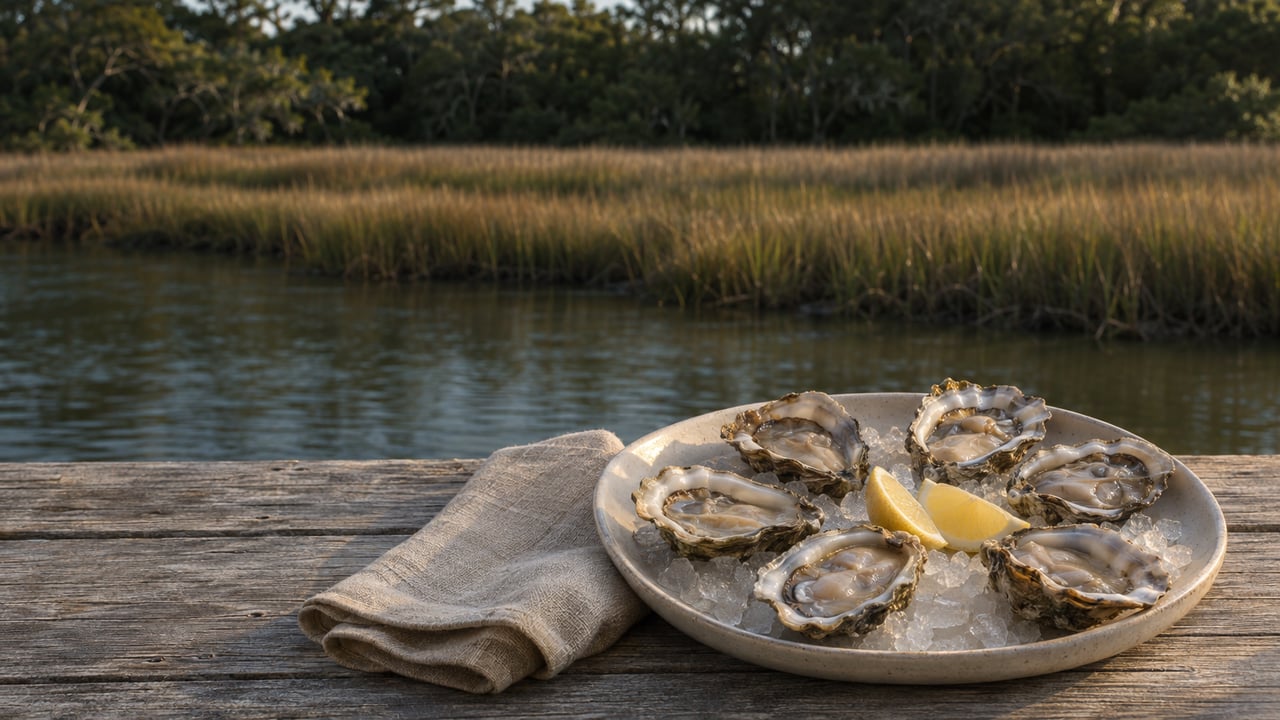
John Parham admits he eats his own product. He told The Brunswick News that every time his family harvests, he puts a sack of 40 oysters in the refrigerator. He calls it "research and development. Quality control." Those oysters grow in floating baskets in Jointer Creek, behind Jekyll Island. Over the past year they have shown up at Georgia Sea Grill, Woodside, Halyards and The Half Shell on St. Simons.
For most of the past century, a raw oyster on an island menu came from somewhere else. This winter, some of them come from a creek behind Jekyll Island, raised by a family that started out growing blueberries.
A Late Start This Fall
This year's season got going later than usual. On October 6, 2026, the Georgia Department of Natural Resources announced that the state's waters would reopen to oyster harvest at 6 a.m. on Thursday, October 8, after higher-than-average September water temperatures kept them closed longer.
The same release says the fall and winter months, after the water cools, are when most people buy shellfish. On St. Simons, those cool months line up with oyster-roast season. By the time you read this, Georgia waters have been open for about six weeks. Restaurants that buy local have had time to restock, and the roast calendar is filling in.
Twenty-Two and a Half Acres Behind Jekyll
The local oyster on a St. Simons menu has a long backstory. As The Brunswick News recounts, Georgia was once a national leader in oyster production, harvesting as many as 8 million pounds of shellfish a year in the early 1900s. By the 1940s the industry had collapsed under overharvesting and falling demand. By the late 2010s, only a handful of licensed harvesters were still pulling wild clusters from coastal creeks.
Wild Georgia oysters tend to grow in clumps. Restaurants want single oysters with a clean shape that look right on the half shell. In 2015, the University of Georgia opened the state's first oyster hatchery in the marshes off Skidaway Island and gave ten growers floating baskets to test whether single oysters could be raised here. Georgia's House Bill 501 became law on March 1, 2020, and floating gear arrived in Georgia waters after it.
The Glynn County piece of that story became official this year. On March 4, 2026, the DNR's Coastal Resources Division announced a new commercial shellfish harvest area on Jointer Creek, south of Cobb Creek. It covers 22.5 acres on the south side of the creek behind Jekyll Island, leased to three parties who grow oysters in floating gear tethered to the bottom. It is the third area of its kind in Georgia, and four concrete pilings installed on January 29, 2026 mark its boundaries.
The Family Behind the Gemstones
Revival Oyster Co. is the name you are most likely to hear at an island table. John and Jennifer Parham run it. Golden Isles Magazine traces the farm to an organic blueberry farm the couple bought, which Parham calls "a pre-COVID midlife crisis." According to The Brunswick News, John works in aviation, Jennifer was a nurse, and the blueberry farm is in Woodbine. Before taking on the farm, Parham worked alongside Karen Sharp of White House Seafood in Camden County, picking wild oysters out of the mud as what he called his "litmus test."
Their seed comes from the UGA extension on Skidaway Island. The oysters grow in floating baskets the family flips and moves to keep algae, barnacles and mud from cutting off the water flow. Each Gemstone takes about nine months to a year to reach market size. The Brunswick News reported that Revival was the first oyster mariculture operation in Glynn County to have its product served on local menus. Parham estimated that as many as 300,000 oysters were growing in the operation, with a long-term goal of a million a year.
The name comes from the colors on the shells, the Parhams told The Brunswick News. The flavor, John Parham says, comes from the water. He told the paper that the nutrient-rich water of the Georgia Bight gives the oysters a salty flavor, adding, "We don't have to do anything. The water provides it."
Four St. Simons Kitchens, and the Places They Used to Order From
Parham told Golden Isles Magazine that the family takes its harvest "straight to the chefs," and he named Georgia Sea Grill, Woodside, Halyard's and The Half Shell as the restaurants that have supported them. The goal he described is five to ten restaurants in the St. Simons and Brunswick area, five or six more around Fernandina Beach and Amelia Island, and possibly Atlanta later.
Georgia Sea Grill shows what has changed. Owner Zack Gowen has owned the restaurant since 2014. He told the magazine that his oysters had come from Pelican Oysters in the Florida Panhandle, from Prince Edward Island and elsewhere in Canada, and from Maine and Massachusetts. He met Parham on the Hwy. 17 Georgia Grown Board back in Parham's blueberry days, and of the Gemstones he said, "the ones we've had have been fantastic." Gowen also said Revival is not the restaurant's only oyster supplier.
A small farm's supply depends on the harvest, so the best way to get a Gemstone is to ask for one by name. When you order oysters on the half shell at any of these four restaurants, ask whether tonight's oysters came from Jointer Creek.
February Under the Oaks at Gascoigne Bluff
St. Simons' biggest oyster night is still a roast. The St. Simons Land Trust has set its 27th annual Oyster Roast for Saturday, February 20, 2027, from 4:30 to 7:30 p.m. under the live oaks at Gascoigne Bluff Park. Golden Isles Magazine's account of the tradition says the roast started at Village Creek Landing with 70 guests, and organizers had to run to the grocery store for more hot dogs. It now draws more than 1,500 people.
The Land Trust credits the oysters to Charlie Williams and Sea Island Forge. Both names belong to the cooks. Williams is one of the owners of Crabdaddy's Seafood Grill and has cooked at the roast since its early years. The magazine reports that his crew steams 300 pounds of oysters at a time, using an electric hoist and a cooker he has owned for more than 20 years. Each batch takes 10 to 15 minutes. Next to him, Steven Schoettle, president of Sea Island Forge, still cooks the old way. In Williams' words, Schoettle uses "kettle-type fire pits that burn wood. You get the metal plate hot and then put a wet rag over the top of them." Sea Island Forge makes handcrafted fire kettles and has a showroom at 257 Redfern Village.
Williams told the magazine he does the oysters for nothing, buying part of them himself while the Land Trust covers the rest. The Land Trust says proceeds help care for the more than 1,400 acres in its trust. That land includes Cannon's Point Preserve, 644 acres of intact maritime forest on the island's north end.
Tickets are $110 for Land Trust members giving at the $100 annual level or higher, and $140 general admission. They include all food, beverages and live music, which this year is Seaside Cliff, a three-piece rock band from St. Simons. Member tickets go on sale Monday, February 1, 2027, with a limit of four discounted tickets per household. General tickets go on sale Tuesday, February 2. If you plan to use the member price, renew your membership before February, as the Land Trust's event page advises.
If February feels too far off, the Jekyll Island Club Resort lists an Oyster Roast on the River at The Wharf on November 27, the day after Thanksgiving, from 11 a.m. to 4 p.m. It is across the water from the creek where the Gemstones grow.
For more of the island's food scene, our look at the newest restaurants at St. Simons' oldest addresses and our St. Simons Island neighborhood guide cover more of the places locals eat.
At JPW Realty, the island's restaurants, roasts and preserves are part of how we talk about St. Simons with every client. If you are thinking about a home within reach of Gascoigne Bluff, the Village or the marsh, schedule a free consultation and we will talk through the island the way locals know it.
